An interactive narrative virtual reality experience · 2026
About the Work
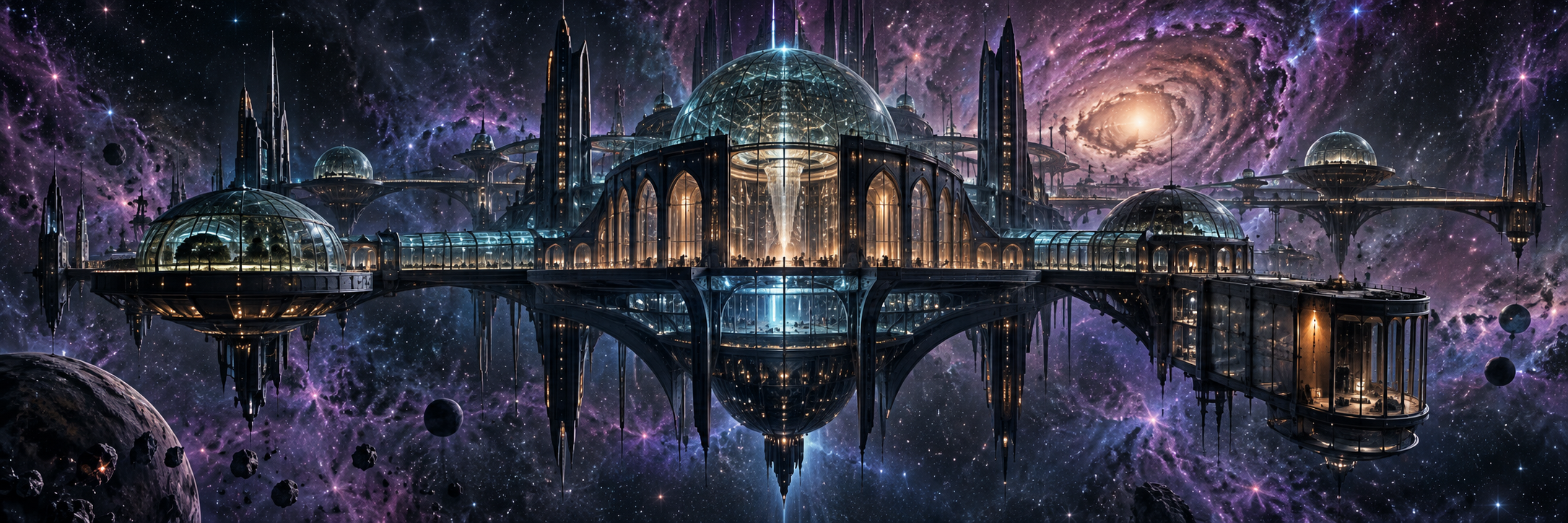
The Grand Hotel Galactic Center is a narrative virtual reality interactive fiction created for the Meta Quest 3 headset. It is the third work in the Visitations series.
Visitations: The Grand Hotels (of Joseph Cornell) is a series of artworks that respond to the imaginary universe of Joseph Cornell's collage series, The Grand Hotels, and the late Robert Coover's book The Grand Hotels (of Joseph Cornell) (2002). Visitations explores different modalities of narrative expression in virtual and augmented environments and is also an exploration of how emerging AI platforms will play a role in the workflow of future immersive reality narratives.
Joseph Cornell created a series of “Hotel” shadowboxes, three-dimensional collage works, such as “The Hotel Eden” (1945), wherein the artist arranged disparate elements – a scrap of a hotel bill, a cutout of a parrot on a twig perch, a drawing of circles, beads, etc., in surreal ways that suggest some kind of undescribed hotel room or untold narrative. Robert Coover pieced together elements of these Cornell boxes into a series of ten prose-poem vignettes that imagine actual Grand Hotels that emerge conceptually from Cornell’s juxtapositions. Coover’s hotel sketches are themselves imaginary spaces driven by metaphysical, ontological, and existential concerns: memory, consciousness, dreams, despair.
For the Visitations project, we have taken Robert Coover’s book as the launching pad for a third layer of adaptation and re-creation. The Visitations projects start with Coover’s hotels and then populate the imagined environments, bringing human interactions and unfolding stories into the hotels first sparked by Coover’s responses to Cornell’s artworks. Each work in the series also serves a different purpose: we are exploring the narrative affordances of a specific mode of immersive storytelling.
The Grand Hotel Galactic Center is perhaps the grandest of the grand hotels—at a glance—but after several days in the bubble you realize why the rooms come so cheap. The clouds are on an infinite loop. The stars are all flickering. Glitzy exteriors concealing broken-down infrastructure. Underneath the glamour, the hotel is like a boarding house maintained without care. The exotic floor show almost makes up for it. But you sense that it is the same every night and that the performers are going through the motions. You might have loved this when you were a child, but your childhood is gone, sapped from you. It is a hotel of both awe and despair.
Galactic Center explores AI text-to-VR environment generation and Gaussian splat technologies as components of a Unity development process.
This work is particularly well suited to the exhibition’s theme of mutable bodies because it traces transformations across narrative and sensory forms, and across generations of materially distinct narrative artworks.
Galactic Center is at the playable prototype stage. Its first public showing will be at the After Virtual Reality exhibition (Bergen International Film Festival, October 2026). We will continue to refine the work for beta release at the 2026 ICIDS exhibition.
Platforms used: Unity, Marble, ChatGPT Image, Adobe Photoshop, and Codex.
Access the Work
The Grand Hotel Galactic Center is currently available as an early Meta Quest 3 prototype. To arrange access or discuss exhibiting the work, contact Scott Rettberg via the UiB Center for Digital Narrative.
Inspirations
Astronomy was one of Joseph Cornell’s lifelong interests and was often a motif within his works. Scholar Kristen A. Hoving published a book on the topic titled Joseph Cornell and Astronomy: A Case for the Stars (Princeton University Press, 2009). Her shorter study, “Joseph Cornell’s Cosmos: An Artist’s Modern Interpretations of Astronomical Myths,” is available online from the journal Culture and Cosmos.
Works such as Andromeda: Grand Hôtel de l’Observatoire (1954), at the Guggenheim Museum, and Celestial Navigation by Birds (circa 1948–1949), at the Museo Nacional Centro de Arte Reina Sofía, may have served as Coover’s inspiration for his story.
Robert Coover’s fiction in response was published in The Grand Hotels (of Joseph Cornell) (Burning Deck, 2002), pages 17–21.
Gallery and Documentation
Views from the playable prototype and its exhibition. The slideshow advances automatically; use the controls to pause or move between images. Select an image to enlarge it.
Video Documentation
A video preview from the developing work.
Exhibitions and Documentation
After Virtual Reality
XR Demo Days at the Bergen International Film Festival and Center for Digital Narrative · Bergen, Norway · October 2026.
ICIDS 2026
Planned beta presentation at the International Conference on Interactive Digital Storytelling · Bangkok, Thailand and online · November–December 2026.
Technical Rider for Exhibition
The work requires a Meta Quest 3 VR headset, a table, a chair, and wall space for a poster. A 2 m × 2 m interaction area should be marked with floor tape to provide sufficient space for viewers to experience the work.
The artists will provide the VR headsets with the work preloaded, along with the poster. Docent assistance may be required to help viewers use the headsets when the artists are not present.
Artists and Collaborators
Roderick Coover, Caitlin Fisher, Scott Rettberg, and Colin Robinson bring together experimental cinema, electronic literature, immersive storytelling, and creative technology.
Roderick Coover is a filmmaker, media artist, and professor at Temple University whose work spans interactive documentary, combinatory cinema, virtual reality, and installation.
Caitlin Fisher is an award-winning writer and media artist, professor at York University, and director of its Immersive Storytelling and Augmented Reality labs.
Scott Rettberg is an author, artist, professor of digital culture, and director of the Center for Digital Narrative at the University of Bergen.
VR development: Colin Robinson, CDN research technologist, engineer, researcher, and game developer, with some contributions from Julien Pillis.
Statement on the Use of AI
The narrative concept, writing, adaptation, and artistic direction of The Grand Hotel Galactic Center are the work of its human authors. Generative systems are used within the production workflow to develop and transform visual and spatial materials, including environments that are subsequently assembled, edited, and programmed in Unity.
The artists approach AI critically as one set of tools among many. The work uses the instability and artifice of generated environments to support its themes of spectacle, repetition, decay, and unreliable memory rather than presenting generated output as autonomous authorship.
Funding and Support

The Grand Hotel Galactic Center was made possible with support from the Research Council of Norway through its SAMKUL project scheme, project number 335129 (Extending Digital Narrative), and through its Centers of Excellence scheme, project number 332643 (Center for Digital Narrative). Additional support of dedicated research time and development support comes from the collaborating artists’ institutions: the University of Bergen, Temple University, and York University.